Maintaining a consistent oral-care routine is less about finding complicated technology and more about making effective brushing easier to perform every day. An electric toothbrush can support that routine by providing powered brush movement, timed brushing sessions, and different operating modes that can be adapted to individual preferences.
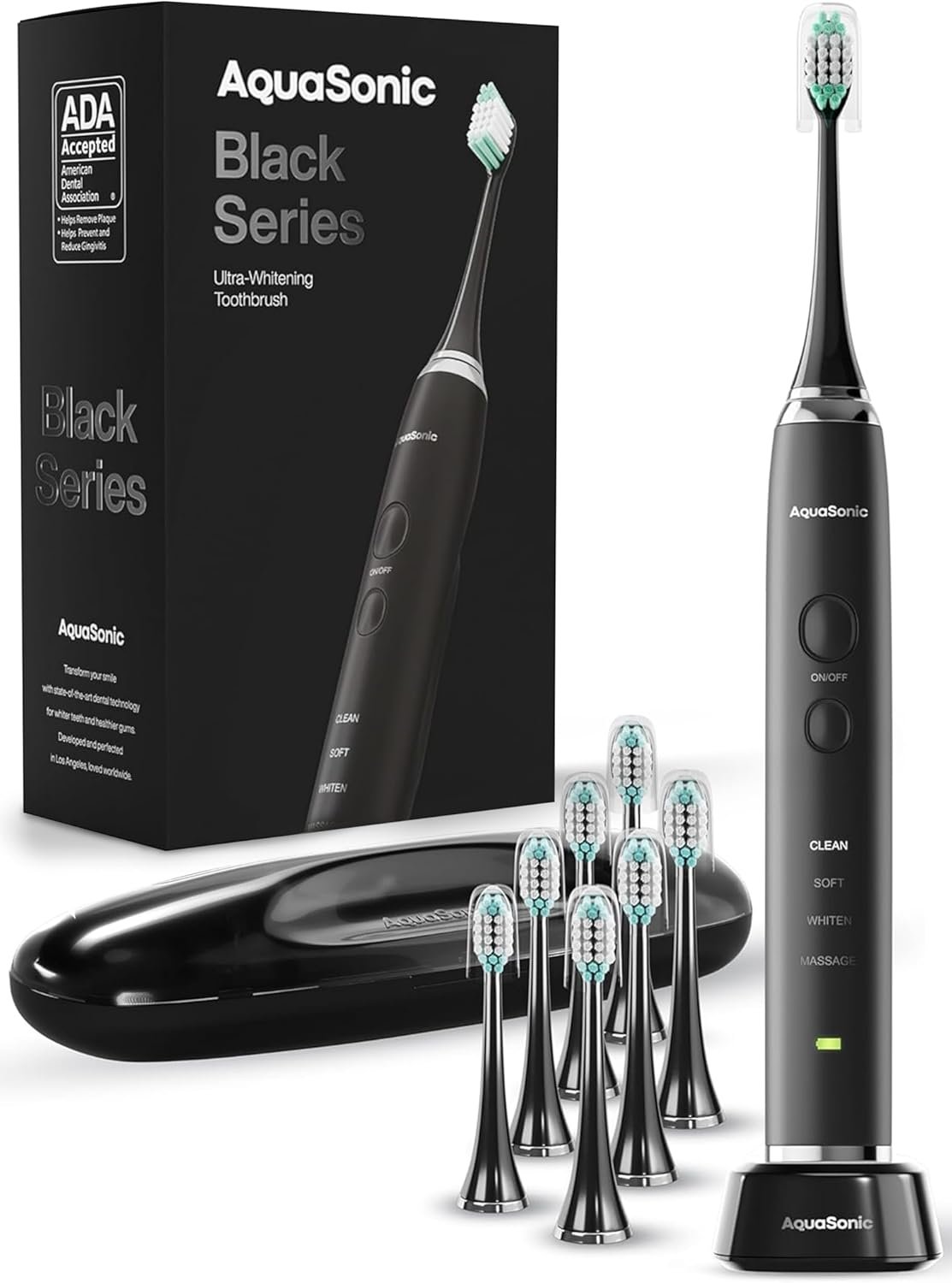
The Aquasonic Black Series Ultra Whitening Toothbrush combines those features in a rechargeable sonic toothbrush designed for everyday oral hygiene. The model includes a 40,000-vibration-per-minute motor, four brushing modes, a built-in timer, wireless charging, eight replacement brush heads, and a travel case. AquaSonic also identifies the Black Series as an ADA-accepted powered toothbrush.
The American Dental Association currently lists the AquaSonic Toothbrush, including the Black Series, among its accepted powered toothbrushes. The ADA states that its acceptance is based on evidence that the product is safe and has demonstrated efficacy in removing plaque and helping prevent and reduce gingivitis when used as directed.
That distinction is important. An ADA Seal of Acceptance is not a statement that one toothbrush is universally preferable to every other option. It indicates that the product has undergone the ADA’s evaluation process for specific safety and effectiveness claims. The ADA explains that powered and manual toothbrushes can both be effective when used appropriately.
This guide explores the Aquasonic Black Series from a practical and educational perspective, including its main features, possible uses, brushing modes, maintenance considerations, travel benefits, and how it compares with broader categories of toothbrushes.
Introduction
A toothbrush has a relatively simple job: help remove plaque and food debris from the teeth and along the gumline. The challenge is consistency.
The American Dental Association recommends brushing twice a day for two minutes with a soft-bristled toothbrush. It also recommends replacing toothbrushes or brush heads approximately every three to four months, or sooner if the bristles become visibly worn.
An electric toothbrush can make this routine more structured by supplying powered movement rather than requiring the user to generate all of the brushing motion manually.
The Aquasonic Black Series uses sonic movement and is specified by the manufacturer at 40,000 vibrations per minute. It provides four operating modes—Clean, Soft, Whiten, and Massage—and incorporates a smart timer intended to help users maintain an appropriate brushing duration.
The package also includes eight brush heads and a hard travel case. AquaSonic states that its included brush heads are designed for approximately three to four months of use each, although actual replacement timing should depend on bristle condition and normal dental-care guidance.
Another practical feature is wireless charging. Rather than connecting a charging cable directly to the toothbrush handle, the handle sits on a compatible charging base.
For people who travel frequently, the included case provides a dedicated way to transport the handle and brush heads while keeping the toothbrush separated from other belongings.
Key Features
40,000 Vibrations Per Minute
One of the most prominent specifications of the Black Series is its 40,000 VPM sonic motor.
VPM stands for vibrations per minute. It describes the frequency of the powered movement generated by the toothbrush.
A high vibration count should not be interpreted by itself as proof that a toothbrush will clean every user’s teeth better. Brushing technique, duration, brush-head condition, pressure, toothpaste, consistency, and individual oral-health needs all matter.
The more useful way to understand the 40,000 VPM specification is that the Black Series uses high-frequency powered movement as its cleaning mechanism rather than relying on the user’s hand to create the brushing motion.
Four Brushing Modes
The Black Series provides four operating modes:
- Clean
- Soft
- Whiten
- Massage
AquaSonic describes these modes as being intended for different aspects of an oral-care routine.
The Clean mode can serve as the general-purpose setting for routine brushing.
The Soft mode can provide a gentler alternative for users who prefer lower-intensity brushing.
The Whiten mode is designed around polishing and surface-stain care rather than replacing professional whitening procedures.
The Massage mode is intended to provide a different brushing experience focused on the gum area.
Having several modes allows users to adjust their routine rather than using exactly the same setting every time.
However, users with sensitive teeth, gum problems, orthodontic appliances, dental restorations, or other specific oral-health concerns should follow advice from their dentist or dental hygienist when selecting a brushing technique and intensity.
Smart Timer
Timing is one of the simplest but most useful features on an electric toothbrush.
The ADA recommends brushing for two minutes twice a day.
The Black Series includes a smart timer designed to guide the brushing session. AquaSonic’s current product information describes smart vibration timers as part of the Black Series design.
A timer can help address a common problem: stopping too early.
Without a timer, it is easy to underestimate how long two minutes actually feels. A dedicated brushing timer provides a consistent reference point and can encourage users to divide attention between different areas of the mouth.
The timer should be viewed as a guide rather than a guarantee of proper brushing. Spending two minutes brushing incorrectly is still different from using appropriate technique and coverage.
ADA Acceptance
The ADA Seal of Acceptance is an important distinction for this product.
The American Dental Association’s current product listing identifies the AquaSonic Toothbrush as an accepted powered toothbrush. Its Seal Statement says the Council on Scientific Affairs found the product safe and found evidence of efficacy in removing plaque and helping prevent and reduce gingivitis when used as directed.
The ADA explains that products receiving its Seal are evaluated against specific scientific requirements, and manufacturers must provide evidence supporting applicable safety and efficacy claims.
It is useful to understand what this means—and what it does not mean.
The Seal does not mean that the toothbrush replaces professional dental care.
It does not mean that users will receive identical results.
It does not mean that the product is appropriate for every individual oral-health situation.
Instead, it provides third-party information about specific safety and effectiveness claims evaluated through the ADA program.
Eight Brush Heads
The Black Series package includes eight replacement brush heads. AquaSonic states that each head is intended to last approximately three to four months under normal use.
This can simplify brush-head replacement because users have several replacements available without needing to purchase another handle.
The ADA recommends replacing toothbrushes every three to four months or earlier if the bristles become visibly matted or frayed.
The condition of the bristles is therefore more important than simply following a calendar.
A user who brushes aggressively may wear bristles more quickly than someone using lighter pressure. Likewise, a brush head may need replacement sooner if it becomes damaged or misshapen.
Wireless Charging
The Black Series uses a wireless charging system.
AquaSonic identifies ultra-fast wireless charging as one of the product’s features.
Wireless charging can be convenient for a bathroom environment because the toothbrush can be placed on its charging base rather than requiring a charging connector to be inserted into the handle.
The charging base can also provide a dedicated location for storing the toothbrush between uses.
As with any electrical device used around water, the charging equipment should be placed and handled according to the manufacturer’s instructions.
Travel Case
The included travel case is designed to make transportation more convenient.
AquaSonic describes the case as a custom hard-shell travel case with room for the toothbrush and two brush heads.
This can be useful for vacations, business travel, gym visits, or other situations where keeping oral-care equipment organized matters.
A case can also help prevent the brush head from coming into direct contact with other objects inside luggage.
Before storing the toothbrush for travel, however, it is sensible to rinse the brush head and allow it to dry appropriately rather than immediately enclosing a wet brush in a closed case for an extended period.
Water-Resistant Design
AquaSonic identifies the Black Series as having an IPX7-rated waterproof design.
An IP rating describes resistance to water under specified testing conditions. It should not be interpreted as permission to use an electronic toothbrush in every possible water environment.
Users should still follow the manufacturer’s instructions concerning cleaning, charging, and exposure to water.
In particular, the charging equipment should be kept in an appropriate location and handled according to its instructions.
How It Can Be Used
Establishing a Consistent Morning Routine
One straightforward use is incorporating the Black Series into a twice-daily routine.
A typical morning routine might include:
- Applying toothpaste to the brush head.
- Starting the selected brushing mode.
- Moving systematically around the mouth.
- Allowing the timer to guide the session.
- Rinsing the mouth and brush head as appropriate.
- Returning the toothbrush to its designated storage or charging location.
The important part is consistency rather than making the routine unnecessarily complicated.
Evening Oral Care
The evening brushing session is another opportunity to use the timer and powered brushing system.
Some people find that a dedicated electric toothbrush makes it easier to establish a predictable bedtime routine because the device provides a consistent start and end point.
If flossing or another interdental-cleaning method is part of an individual’s dental-care routine, that can be incorporated separately according to dental-professional guidance.
Using the Soft Mode
The Soft setting may be useful for users who prefer a gentler brushing sensation.
It is important not to interpret “soft” as a treatment for a specific dental condition. People experiencing persistent sensitivity, bleeding gums, pain, recession, or other concerns should discuss those symptoms with a dental professional rather than simply changing toothbrush settings and assuming the issue will resolve.
Using the Whiten Mode
The Whiten mode is designed around polishing and surface-stain care.
Surface discoloration can occur from foods and drinks such as coffee, tea, or other staining substances. A toothbrush can help maintain cleanliness and may help remove some surface deposits.
However, brushing is not equivalent to professional or chemical tooth whitening.
The color of teeth can be influenced by factors that brushing alone cannot change, including intrinsic tooth color and certain forms of discoloration.
For that reason, a whitening-oriented brushing mode should be understood as part of routine oral hygiene rather than a substitute for professional whitening treatment.
Using the Massage Mode
The Massage setting provides another brushing option intended for the gum area.
Gums should be treated gently. Applying excessive pressure does not necessarily improve cleaning and may contribute to irritation or damage.
Users should follow the manufacturer’s instructions and dental-professional guidance regarding appropriate pressure and technique.
Travel
The travel case makes the Black Series suitable for maintaining a similar brushing setup away from home.
Travel can disrupt oral-care routines because people sometimes leave behind chargers, brush heads, or other accessories.
Keeping the toothbrush, replacement heads, and case together can make the routine more portable.
For longer trips, users should also consider the availability of the appropriate power source and charging equipment at their destination.
Who It May Be Suitable For
Adults Seeking a Powered Alternative
The Black Series is intended as an adult electric toothbrush and can be considered by people who want an alternative to manual brushing.
The ADA notes that both manual and powered toothbrushes can be effective. It also notes that powered toothbrushes may be particularly useful for some people with dexterity limitations.
That does not mean every person with limited dexterity should automatically choose this specific model. Individual comfort and dental needs still matter.
People Who Prefer Timed Brushing
Someone who regularly loses track of brushing time may appreciate an integrated timer.
A timer can make the recommended two-minute routine more structured without requiring the user to watch a clock.
Frequent Travelers
The combination of rechargeable operation, multiple replacement brush heads, and a travel case can be practical for people who frequently travel.
Instead of assembling a separate travel toothbrush setup, users can transport the same powered toothbrush system.
Users Interested in Multiple Modes
Some people prefer having different operating options rather than a single fixed setting.
The four modes provide a way to choose between general cleaning, softer brushing, whitening-oriented polishing, and massage-oriented use.
People Looking for an ADA-Accepted Powered Toothbrush
The ADA currently lists AquaSonic Toothbrush among accepted powered toothbrushes.
For consumers who specifically want an electric toothbrush with an ADA Seal of Acceptance, this is a relevant characteristic to consider.
Important Things to Consider
Technique Still Matters
An electric motor does not automatically guarantee thorough brushing.
Users still need to position the brush head appropriately and move it systematically around the mouth.
The ADA recommends brushing twice daily for two minutes with a soft-bristled toothbrush.
An effective routine therefore involves both the device and the way it is used.
Avoid Excessive Pressure
More pressure is not necessarily better.
Aggressive brushing can be uncomfortable and may contribute to gum irritation or tooth wear in some circumstances.
A powered toothbrush should generally be allowed to perform its intended movement without the user forcing it aggressively against the teeth.
Anyone concerned about brushing pressure, gum recession, sensitivity, or bleeding should ask a dentist or dental hygienist for individualized guidance.
Brush Head Replacement
Having eight brush heads does not mean every head should automatically be used for exactly the same number of months.
AquaSonic describes its included heads as lasting approximately three to four months each, while the ADA recommends replacement every three to four months or earlier if bristles become worn.
Visual inspection is therefore useful.
If the bristles become frayed, flattened, or visibly damaged, replacing the head may be appropriate even if the expected time period has not elapsed.
Dental Appliances and Special Circumstances
People with braces, implants, crowns, veneers, gum disease, recent dental procedures, or other specific oral-health situations may have different brushing requirements.
The ADA notes that powered toothbrushes can be useful for people with dental appliances such as braces, but individual recommendations can vary.
A dentist or orthodontist can provide instructions appropriate to the specific appliance or condition.
Whitening Expectations
The term “whitening” can create unrealistic expectations if it is interpreted as professional tooth bleaching.
The Black Series includes a Whiten mode, but a toothbrush primarily supports mechanical cleaning and surface-stain removal.
If discoloration is persistent or a person wants a significant change in tooth shade, professional dental advice may be more appropriate than simply increasing brushing intensity.
Charging and Storage
Wireless charging adds convenience, but the toothbrush still needs to be stored in a sensible location.
The charging base should not be treated like a waterproof bathroom accessory unless the manufacturer specifically states that the base itself has equivalent water resistance.
Keeping electrical components away from direct splashes can help protect the equipment and reduce avoidable risks.
Personal Oral-Health Needs
A product that works well for general daily hygiene may not address a specific dental problem.
Persistent bleeding, swelling, pain, sensitivity, loose teeth, sores, or other unusual symptoms should not simply be treated by changing toothbrush settings.
Those situations warrant professional dental evaluation.
Comparing General Toothbrush Categories
Manual Toothbrushes
Manual toothbrushes remain a straightforward option for everyday oral hygiene.
They do not require charging, batteries, electronic components, or replacement charging equipment.
They can also be inexpensive and easy to travel with.
The trade-off is that the user must provide the brushing movement and manage brushing time without the assistance of a built-in motor or timer.
The ADA recognizes manual toothbrushes as an effective option when used properly.
Basic Electric Toothbrushes
Basic rechargeable or battery-powered toothbrushes add powered movement without necessarily offering multiple modes or extensive accessories.
They can be a reasonable middle ground for people who want powered brushing but do not need additional features.
Compared with a basic electric toothbrush, the Black Series adds four modes, a smart timer, wireless charging, multiple brush heads, and a travel case.
Sonic Toothbrushes
Sonic toothbrushes use high-frequency powered movement.
The Black Series falls within this category and specifies 40,000 vibrations per minute.
Different sonic toothbrushes can vary considerably in motor specifications, head design, timing functions, battery systems, and modes.
The number of vibrations alone should not be treated as a complete measure of oral-care effectiveness.
Premium Smart Toothbrushes
Some higher-end electric toothbrushes add smartphone applications, pressure sensors, brushing maps, Bluetooth connectivity, and other feedback features.
Those technologies may appeal to people who want detailed tracking.
The Black Series takes a more straightforward approach, concentrating on physical controls, multiple brushing modes, timing, charging, and included accessories rather than requiring an extensive connected-app ecosystem for everyday brushing.
Travel Electric Toothbrushes
Compact travel-oriented toothbrushes often emphasize portability and smaller charging systems.
The Black Series is somewhat different because it is a full-size rechargeable toothbrush supplied with a dedicated travel case.
For frequent travelers, the included case may be useful, while users who prioritize the smallest possible luggage footprint may prefer a purpose-built compact travel model.
Practical Maintenance Tips
Taking care of the toothbrush can help keep the daily routine consistent.
After brushing, rinse the brush head thoroughly according to the manufacturer’s instructions.
Allowing the brush head to dry between uses is also useful. A permanently enclosed, wet brush head is less desirable than allowing appropriate air circulation.
Keep replacement brush heads stored in a clean, dry location.
Inspect the bristles periodically rather than waiting for them to become severely damaged.
The handle and charging equipment should be cleaned according to the manufacturer’s instructions.
When traveling, the case can help organize the toothbrush and replacement heads, but it is sensible to avoid packing a visibly wet brush immediately before closing the case for an extended period.
Frequently Asked Questions
Is the Aquasonic Black Series ADA accepted?
Yes. The American Dental Association currently lists the AquaSonic Toothbrush, including the Black Series among its accepted powered toothbrushes. The ADA’s Seal Statement says the product has demonstrated safety and efficacy in removing plaque and helping prevent and reduce gingivitis when used as directed.
What does ADA acceptance actually mean?
The ADA Seal of Acceptance indicates that the product has been evaluated against the program’s scientific requirements for applicable safety and effectiveness claims. It does not mean that the toothbrush is universally superior to all other toothbrushes.
How many vibrations per minute does the Black Series have?
The Aquasonic Black Series is specified at 40,000 vibrations per minute.
How many brushing modes are included?
The Black Series provides four modes: Clean, Soft, Whiten, and Massage.
Does it have a timer?
Yes. The Black Series includes a smart vibration timer designed to help guide brushing sessions.
The ADA recommends brushing for two minutes twice a day.
Does the toothbrush use wireless charging?
Yes. AquaSonic lists wireless charging as one of the Black Series features.
How many brush heads are included?
The Black Series package includes eight brush heads. AquaSonic states that each head is designed to last approximately three to four months.
Actual replacement timing should also take bristle condition into account, consistent with ADA guidance.
Does it include a travel case?
Yes. The package includes a custom hard-shell travel case designed to hold the toothbrush and two brush heads.
Is the Black Series waterproof?
AquaSonic describes the toothbrush handle as having an IPX7-rated waterproof design.
Users should still follow the manufacturer’s instructions concerning water exposure, cleaning, charging, and storage.
Can the Whiten mode replace professional teeth whitening?
No. A whitening-oriented toothbrush mode should not be considered equivalent to professional or chemical tooth-whitening procedures.
Its role is within everyday oral hygiene and surface-stain care.
How often should the brush head be replaced?
The ADA recommends replacing toothbrushes every three to four months, or sooner when the bristles are visibly worn or frayed.
AquaSonic similarly describes its included brush heads as lasting approximately three to four months.
Can people with sensitive teeth use it?
Some users may prefer the Soft mode, but sensitivity can have many causes. Anyone experiencing persistent or significant sensitivity should consult a dental professional for individualized advice rather than relying solely on a different toothbrush setting.
Is an electric toothbrush necessary for good oral hygiene?
No. The ADA states that both manual and powered toothbrushes can be effective.
The potential advantage of a powered toothbrush is that it can provide consistent mechanical movement and, depending on the model, features such as timers and multiple settings.
Is the Black Series suitable for children?
The product discussed here is an adult-oriented toothbrush. Children have different oral-care requirements, and caregivers should follow age-appropriate dental guidance. The ADA recommends that brushing begin when the first tooth erupts and that caregivers assist or supervise children until they can reliably spit out excess toothpaste.
Can it replace flossing?
A toothbrush primarily cleans accessible tooth surfaces. It should not automatically be considered a replacement for all forms of interdental cleaning.
The appropriate approach to cleaning between teeth depends on an individual’s dental situation, and a dental professional can recommend suitable methods.
Conclusion
The Aquasonic Black Series Ultra Whitening Toothbrush combines powered sonic brushing with several features intended to make a daily oral-care routine more structured.
Its 40,000-vibration-per-minute motor, four brushing modes, smart timer, wireless charging system, eight included brush heads, and travel case provide a range of practical functions in one rechargeable toothbrush.
Its ADA acceptance is another important point of distinction. The American Dental Association states that the AquaSonic Toothbrush has demonstrated safety and efficacy for removing plaque and helping prevent and reduce gingivitis when used as directed.
At the same time, the technology should be viewed as a tool rather than a substitute for good brushing habits or professional dental care. Proper technique, appropriate brushing time, sensible pressure, regular brush-head replacement, and routine dental visits remain important parts of oral hygiene.
The different modes can provide flexibility, while the timer can help establish a consistent two-minute brushing routine. The travel case and rechargeable design may also make it practical for people who want to maintain the same oral-care setup while away from home.
For anyone comparing manual toothbrushes, basic electric models, sonic toothbrushes, and more advanced connected systems, the key question is not simply how many features a toothbrush has. It is whether those features support a consistent routine that fits the user’s needs and preferences.
You can check more details on Amazon here.
Amazon Associates Disclosure: As an Amazon Associate, we earn from qualifying purchases.
Leave a Reply