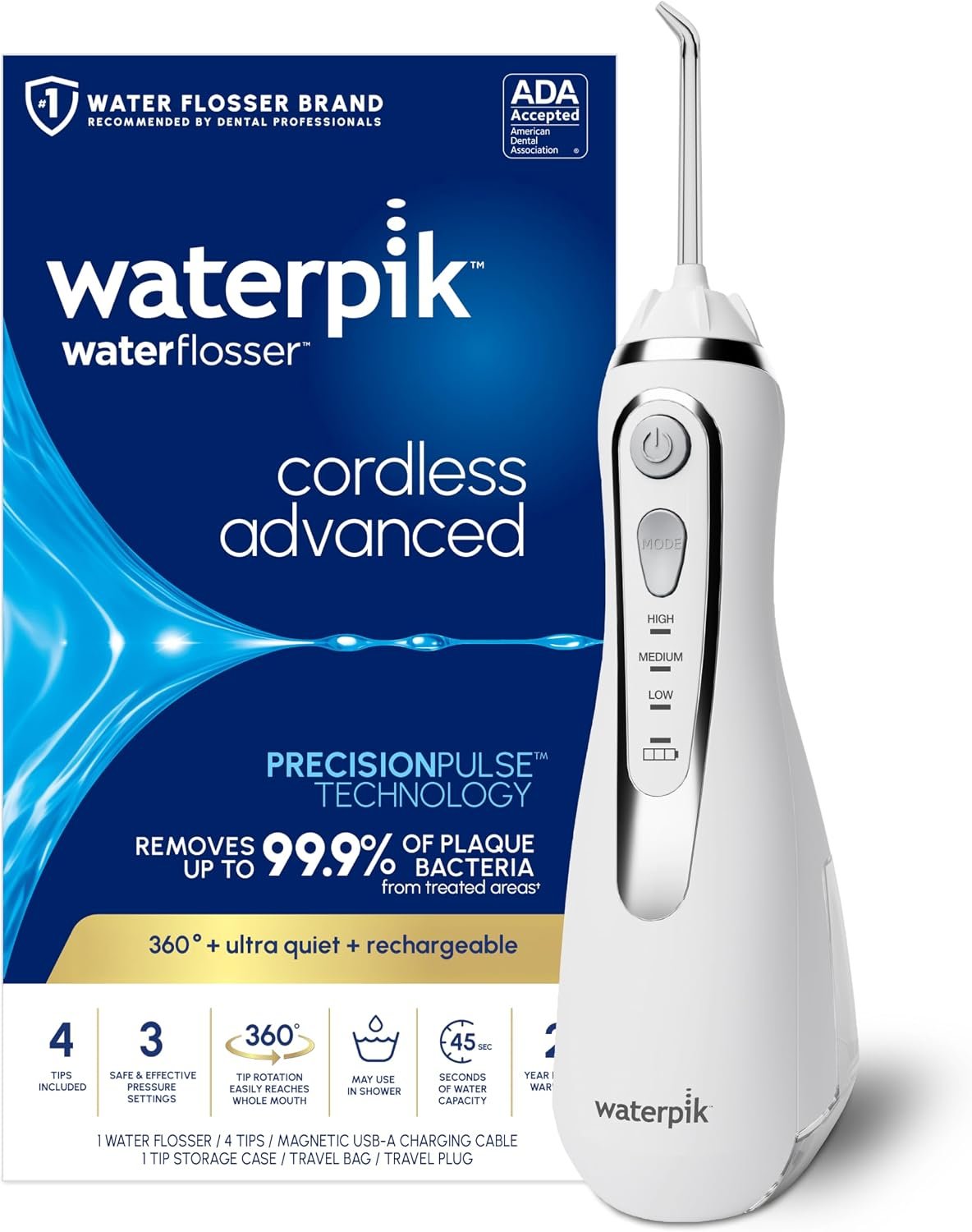
Cleaning between the teeth is an important part of maintaining an everyday oral-care routine. A toothbrush primarily cleans the accessible surfaces of the teeth, while interdental cleaning helps address areas that are harder to reach with brushing alone. Traditional dental floss remains one option, but some people prefer using a water flosser that directs a controlled stream of water around and between the teeth.
The Waterpik Cordless Advanced Portable Water Flosser is a rechargeable oral irrigator designed for people who want a cordless alternative to a countertop water flosser. The white version referenced here is part of Waterpik’s Cordless Advanced family and is designed around portable use, rechargeable operation, multiple pressure settings, and interchangeable tips.
Waterpik describes the Cordless Advanced as a rechargeable cordless water flosser with three pressure settings, a 45-second water reservoir, a magnetic charging system, a rotating tip handle, and a waterproof design intended for shower use. The manufacturer also identifies it as ADA accepted.
The American Dental Association’s Seal of Acceptance is relevant because it provides information beyond a manufacturer’s own marketing claims. The ADA explains that products carrying the Seal have been evaluated according to its requirements for safety and effectiveness for the claims being made.
At the same time, a water flosser should be understood as an oral-hygiene tool rather than a replacement for professional dental care. The appropriate method of cleaning between teeth can vary depending on a person’s dental health, restorations, orthodontic appliances, and preferences.
This guide explains how the Waterpik Cordless Advanced works, the role of its different features, practical ways to incorporate it into an oral-care routine, and factors worth considering before choosing a cordless water flosser.
Introduction
Daily brushing is only one part of an effective oral-care routine.
The spaces between teeth and areas around the gumline can be difficult to clean with a toothbrush alone. Interdental cleaning methods are designed to address those areas.
Traditional string floss works by physically sliding between teeth to remove plaque and debris. Interdental brushes can also be useful in appropriate spaces. A water flosser takes a different approach: it uses a stream of pulsating water to clean around teeth and along the gumline.
The Waterpik Cordless Advanced is designed to make that approach more portable.
Unlike countertop water flossers that remain beside a sink, the Cordless Advanced contains its reservoir, pump, battery, and controls in a single handheld unit. This means it can be moved more easily between locations.
The manufacturer describes the model as waterproof and suitable for use in the shower.
That portability can be particularly relevant to people who travel frequently or have limited bathroom counter space.
The device also offers three pressure settings, allowing users to select a level that feels appropriate for their needs. A lower setting may be more comfortable for someone who is new to water flossing, while another user may prefer a higher setting.
The goal should not be maximum pressure. Interdental cleaning is about consistent coverage and appropriate technique rather than simply using the strongest setting.
Key Features
Cordless Rechargeable Design
The most obvious difference between the Cordless Advanced and a countertop water flosser is the lack of a permanent power cable.
The device uses a rechargeable battery, allowing the user to operate it without connecting the handle to an electrical outlet during each session. Waterpik describes the Cordless Advanced as rechargeable and portable.
This can simplify bathroom organization.
There is no need to keep the unit beside an outlet while flossing, and the device can be stored more easily when not in use.
Rechargeable operation also makes the product useful for travel. Instead of packing a larger countertop unit, a user can take a single handheld device and its compatible accessories.
The trade-off is that battery charging becomes part of the routine. A user who travels frequently should make sure the device is charged before leaving.
Three Pressure Settings
The Cordless Advanced provides three water-pressure settings.
Having adjustable pressure is useful because people’s comfort levels can differ.
Someone new to water flossing may prefer to begin with the lowest setting.
A person accustomed to oral irrigation may prefer a stronger stream.
Pressure can also affect how easy it is to control the water around the gumline.
It is important not to assume that the highest setting provides better cleaning. Excessive pressure can be uncomfortable and may irritate sensitive gums.
A sensible approach is to start at a comfortable level and adjust gradually if needed.
45-Second Water Reservoir
The Cordless Advanced uses an integrated water reservoir that Waterpik specifies as providing up to 45 seconds of flossing time.
A 45-second reservoir is a different design choice from larger countertop water flossers that can operate for longer periods without refilling.
For a portable device, the smaller reservoir helps keep the unit compact.
The practical routine is straightforward:
- Fill the reservoir with water.
- Select the appropriate pressure.
- Position the tip in the mouth before activating the device.
- Work systematically around the teeth.
- Refill if additional water is needed.
The required amount of water can depend on technique, pressure setting, and how quickly the user moves from one area to another.
Magnetic Charging System
Waterpik describes the Cordless Advanced as using a magnetic charging system.
A magnetic charging connection can make placing the device on its charger relatively straightforward.
Because the product is intended for bathroom use, users should still follow the manufacturer’s charging instructions and keep electrical components appropriately protected from water.
The charging system should be treated separately from the waterproof characteristics of the handheld unit.
Rotating Tip Handle
The Cordless Advanced incorporates a rotating handle that allows the user to adjust the angle of the water-flossing tip. Waterpik lists the rotating tip handle among the product’s features.
This can make it easier to reach different parts of the mouth without having to rotate the entire device awkwardly.
A water flosser requires some coordination because the user must control both the angle of the tip and the movement of the handle.
The rotating mechanism provides another way to adjust positioning.
Multiple Interchangeable Tips
Waterpik supplies multiple tips with the Cordless Advanced, with the exact tip selection depending on the specific package and product version.
Waterpik’s current product information identifies multiple tip types for the Cordless Advanced, including the Orthodontic Tip, Plaque Seeker Tip, and Classic Jet Tip.
Different tips are designed around different oral-care situations.
The Classic Jet Tip is the general-purpose option for everyday water flossing.
The Orthodontic Tip is designed for cleaning around orthodontic appliances.
The Plaque Seeker Tip is intended for cleaning around dental work such as implants, crowns, bridges, and other areas where additional attention may be useful.
Users should follow Waterpik’s instructions for the correct use of each tip.
Waterproof Construction
Waterpik describes the Cordless Advanced as waterproof and suitable for use in the shower.
This can be particularly convenient for people who prefer to use a water flosser in the shower.
The waterproof design can also make rinsing and cleaning the handheld unit easier, within the limits of the manufacturer’s instructions.
However, waterproofing should not be interpreted as meaning that every component, especially the charging equipment, can be submerged or exposed to water without restriction.
ADA Acceptance
The American Dental Association’s Seal of Acceptance is one of the product’s notable characteristics.
The ADA explains that its Seal program evaluates products according to requirements involving safety and effectiveness for their intended claims.
Waterpik identifies the Cordless Advanced as ADA accepted, and the ADA’s product database includes Waterpik water flosser products within its accepted category.
The Seal should be interpreted carefully.
It does not mean that every person must use a water flosser.
It does not replace professional dental advice.
It also does not mean that one particular model will produce identical results for every individual.
Instead, it provides independent information about the product’s evaluation under the ADA’s acceptance program.
How It Can Be Used
As Part of a Morning Routine
A water flosser can be incorporated into a normal morning oral-care routine.
One possible sequence is:
- Rinse or prepare the water flosser.
- Fill the reservoir.
- Select a comfortable pressure.
- Place the tip inside the mouth before activating the water.
- Direct the stream along the gumline and between teeth.
- Work systematically through the mouth.
- Rinse the device and empty or dry it according to the manufacturer’s instructions.
The precise order relative to brushing can vary according to personal preference and dental guidance.
The most important consideration is consistency.
Evening Oral Care
Some people may find interdental cleaning particularly convenient in the evening because it provides an opportunity to remove food debris accumulated throughout the day.
The water flosser can be used before or after brushing depending on the individual’s routine.
If a dentist or dental hygienist has recommended a specific order, that recommendation should take priority.
Around Braces
Orthodontic appliances can create additional spaces where food particles and plaque may accumulate.
Waterpik’s Orthodontic Tip is specifically designed for use around orthodontic appliances.
A water flosser can therefore be a useful addition to an orthodontic-care routine.
People wearing braces should still follow the cleaning instructions provided by their orthodontist.
A water flosser does not automatically replace other recommended cleaning methods.
Around Dental Work
Dental implants, bridges, crowns, and other restorations can create areas that require careful cleaning.
Waterpik’s Plaque Seeker Tip is designed for use around dental work.
This can make interchangeable tips particularly useful for people whose oral-care routine involves more than natural teeth.
However, dental restorations vary considerably.
If someone has recently received an implant, crown, bridge, periodontal treatment, or other dental work, the dentist should provide the appropriate cleaning instructions.
For People Who Find String Floss Difficult
Traditional floss requires a certain amount of finger control and technique.
Some people find it difficult to manipulate string floss around every tooth.
The ADA notes that powered interdental cleaning devices can provide an alternative method for cleaning between teeth.
A water flosser may therefore be attractive to users who struggle with conventional flossing.
That does not mean it is automatically the correct choice for everyone.
While Traveling
Portability is one of the clearest applications for the Cordless Advanced.
A countertop water flosser can be inconvenient to pack because it may include a large base, reservoir, tubing, and power cable.
A cordless model consolidates those components into a handheld format.
The user can charge it before traveling and transport it with its appropriate accessories.
When traveling internationally, users should also consider the electrical specifications of the charger and the power standards at their destination.
In a Small Bathroom
A countertop water flosser requires counter space.
A cordless model can reduce the amount of permanent space needed.
This can be useful in apartments, shared bathrooms, dormitories, or other environments where countertop space is limited.
The device can be stored away when it is not being used.
Who It May Be Suitable For
Frequent Travelers
People who regularly travel for work or leisure may appreciate the compact format.
The ability to use a rechargeable handheld device can make maintaining an interdental-cleaning routine easier away from home.
People With Limited Counter Space
A portable water flosser does not need a permanent countertop location.
That can make it practical for smaller bathrooms.
People Wearing Braces
The orthodontic tip and water-based cleaning method may be useful for people who need to clean around orthodontic appliances.
Orthodontic patients should still follow their orthodontist’s instructions.
People With Dental Restorations
Users with implants, bridges, crowns, and similar dental work may appreciate a dedicated tip designed around those areas.
Individual dental recommendations should determine how and where the device is used.
People Who Prefer Water-Based Interdental Cleaning
Some people simply prefer the sensation and technique of a water flosser over string floss.
A rechargeable model offers a way to use that approach without a large countertop appliance.
People With Certain Dexterity Challenges
Manipulating traditional floss can be difficult for some individuals.
A water flosser requires a different type of hand movement and may be easier for some people to operate.
The ADA recognizes that powered oral-care devices can be useful for people who have difficulty using traditional methods, although individual suitability varies.
Important Things to Consider
Water Flossing Does Not Replace Dental Visits
A water flosser is an oral-hygiene tool.
It cannot diagnose cavities, gum disease, infections, damaged restorations, or other dental problems.
Regular dental examinations remain important.
If the gums frequently bleed, swell, become painful, or change in appearance, professional evaluation is appropriate rather than simply increasing water-flossing intensity.
Technique Matters
Using a water flosser effectively requires more than pointing the stream randomly around the mouth.
A systematic approach is generally easier.
Start at one side of the mouth and work toward the other.
Pay attention to both the spaces between teeth and the gumline.
The tip should be positioned according to the manufacturer’s instructions, and the pressure should remain comfortable.
Start With Lower Pressure
Someone new to water flossing may initially find the sensation unfamiliar.
Starting at a lower pressure can provide an opportunity to learn how the device behaves.
Once comfortable, the pressure can be adjusted as needed.
Higher pressure is not inherently better.
Water Temperature
Cold tap water can feel uncomfortable for people with sensitive teeth.
Room-temperature or lukewarm water may be more comfortable.
Extremely hot water should not be used.
The water should be comfortable rather than hot.
Reservoir Refilling
The 45-second reservoir is compact but requires more frequent filling than a larger countertop unit.
For some users, that is a minor inconvenience.
For others, particularly those who prefer longer uninterrupted sessions, a countertop model with a larger reservoir may be more practical.
Battery Charging
A cordless device needs a charging routine.
If the battery becomes depleted, the user may not be able to use the water flosser immediately.
Charging the device regularly can help avoid this issue.
Travelers should also remember to pack the charging equipment rather than assuming the battery will last indefinitely.
Cleaning and Drying
Water is an essential part of the device’s operation, but stagnant water can create hygiene concerns.
The reservoir should be emptied and cleaned according to the manufacturer’s instructions.
The nozzle should also be rinsed and maintained appropriately.
Allowing components to dry can help keep the device fresh between uses.
Waterproof Does Not Mean Indestructible
The Cordless Advanced is designed for water exposure, including shower use.
That does not mean the device should be dropped, submerged outside its intended conditions, or handled carelessly.
Users should follow the manufacturer’s instructions for cleaning, storage, and charging.
Gum Sensitivity
Some people may experience temporary sensitivity when beginning an interdental-cleaning routine.
If water flossing causes persistent pain, significant bleeding, or worsening symptoms, it is sensible to stop and consult a dental professional.
The objective is effective cleaning without unnecessary irritation.
Orthodontic and Dental Work
People with braces, implants, bridges, crowns, periodontal treatment, or recent dental procedures should follow the cleaning instructions provided by their dentist or orthodontist.
The correct pressure and technique may differ depending on the situation.
Comparison of General Categories
Traditional String Floss
Traditional floss remains one of the most established ways to clean between teeth.
It is inexpensive, compact, requires no electricity, and can be carried almost anywhere.
The main challenge for some users is technique. Proper flossing requires the string to be positioned and moved carefully around the sides of the teeth.
A water flosser uses a different mechanism and may feel easier for certain people.
Neither approach eliminates the need for consistent oral hygiene.
Interdental Brushes
Interdental brushes are small brushes designed to clean between teeth.
They can be useful when spaces between teeth are large enough to accommodate them.
Their effectiveness depends on choosing an appropriate size and using the correct technique.
A water flosser provides a different approach that does not require inserting a brush into each space.
Countertop Water Flossers
Countertop water flossers generally provide larger reservoirs and more extensive controls.
They may be suitable for households where the device remains in one bathroom.
Their main limitation is size.
The Cordless Advanced is designed around portability and reduced counter requirements rather than a large stationary setup.
Cordless Water Flossers
Cordless models combine a reservoir, battery, pump, and controls into one portable device.
They can be convenient for travel and smaller bathrooms.
The trade-offs can include shorter operating sessions, smaller reservoirs, and the need for battery charging.
Manual Oral Irrigation Devices
Some oral-irrigation systems rely on manually operated water pressure rather than an electric pump.
These can be simple and portable but generally do not provide the same powered pulsation or adjustable electronic pressure control found in rechargeable models.
The appropriate choice depends on the user’s preferences and routine.
Practical Water-Flossing Technique
A consistent technique can make the process easier.
Start by filling the reservoir with clean water.
Select a lower pressure setting if you are new to the device.
Place the tip inside the mouth before switching on the water to reduce splashing.
Lean over the sink if you are not using the device in the shower.
Allow the water to flow into the sink while guiding the tip along the gumline and between teeth.
Move systematically from one area to another rather than repeatedly concentrating on the same teeth.
The exact technique may vary depending on the tip being used.
For braces or dental restorations, follow the instructions provided by the dental professional and the manufacturer.
After finishing, turn off the device, empty or clean the reservoir as recommended, rinse the tip, and store the equipment appropriately.
Maintaining the Water Flosser
Maintenance is a relatively small part of using a water flosser, but it matters.
The reservoir should be cleaned regularly.
The nozzle should be rinsed after use.
Any removable components should be maintained according to Waterpik’s instructions.
The outside of the unit can be cleaned as directed without exposing electrical charging components to unnecessary moisture.
Replacement tips should also be changed according to the manufacturer’s recommendations.
Different users may need replacements at different intervals depending on use and condition.
Keeping the device clean also makes it easier to integrate into a consistent routine.
Frequently Asked Questions
What is the Waterpik Cordless Advanced?
The Waterpik Cordless Advanced is a rechargeable cordless water flosser designed for cleaning between teeth and around the gumline using a pulsating stream of water. Waterpik describes it as a portable model with adjustable pressure and multiple interchangeable tips.
Is the Cordless Advanced rechargeable?
Yes. It uses a rechargeable battery and a magnetic charging system.
How many pressure settings does it have?
The Cordless Advanced provides three pressure settings.
How long does the water reservoir last?
Waterpik specifies up to 45 seconds of flossing time from the integrated reservoir.
Actual usage time can vary depending on pressure and technique.
Can it be used in the shower?
Yes. Waterpik describes the Cordless Advanced as waterproof and suitable for shower use.
Users should still follow the manufacturer’s instructions regarding charging and care.
Does it include different tips?
Yes. Waterpik offers multiple interchangeable tips for the Cordless Advanced, including general-purpose and specialized tips. Current product information identifies Classic Jet, Orthodontic, and Plaque Seeker options.
What is the Orthodontic Tip used for?
The Orthodontic Tip is designed to help clean around orthodontic appliances such as braces.
People with braces should still follow their orthodontist’s specific cleaning recommendations.
What is the Plaque Seeker Tip?
The Plaque Seeker Tip is designed for use around dental work such as implants, crowns, and bridges.
The appropriate technique should be confirmed with a dental professional when dental restorations are involved.
Is water flossing the same as traditional flossing?
No. Traditional floss physically cleans between teeth with a strand of floss, while a water flosser uses a stream of water.
They are different interdental-cleaning approaches.
Can a water flosser replace string floss?
For some people, a water flosser may serve as their preferred interdental-cleaning method. However, the most appropriate method depends on individual dental needs.
A dentist or dental hygienist can recommend the approach most appropriate for a particular mouth.
Does the ADA accept the Waterpik Cordless Advanced?
Waterpik states that the Cordless Advanced has ADA acceptance, and the ADA maintains an acceptance program for oral-care products based on safety and effectiveness requirements.
The ADA Seal should be understood as information about the product’s evaluated claims rather than a universal ranking of oral-care products.
Can it be used with braces?
Yes. Waterpik offers an Orthodontic Tip intended for cleaning around braces.
Orthodontic patients should follow their orthodontist’s instructions.
Can it be used around implants?
The Plaque Seeker Tip is designed for use around dental work including implants.
Anyone with recent implant treatment should follow the implant dentist’s instructions.
Is the Cordless Advanced suitable for travel?
Its cordless rechargeable format is designed for portability and can be useful for travel.
Users should remember to bring the charging equipment and verify power compatibility when traveling internationally.
Does it require a countertop?
No. The cordless design is intended to reduce the need for a permanent countertop setup.
It can be stored between uses.
Is it suitable for small bathrooms?
It may be practical in a smaller bathroom because it does not require the same permanent countertop footprint as a large countertop water flosser.
Can children use it?
Children should use oral-care devices according to age-appropriate guidance and caregiver supervision.
The appropriate water pressure and technique can vary by age, so parents should follow dental-professional recommendations.
Can people with sensitive gums use it?
Some users with sensitivity may prefer starting at a lower pressure.
Persistent bleeding, pain, swelling, or other unusual symptoms should be discussed with a dental professional rather than treated simply by changing water pressure.
Should the water flosser be used before or after brushing?
There is not necessarily one universal sequence for every person. What matters most is maintaining a consistent oral-care routine.
If a dentist or hygienist has provided specific instructions, those should take priority.
How should the reservoir be cleaned?
The reservoir should be cleaned according to Waterpik’s instructions. Regular cleaning and drying can help maintain the device and prevent stagnant water from remaining inside.
How often should the tips be replaced?
Replacement intervals depend on the type of tip and how it is used. Users should follow Waterpik’s current replacement guidance and replace tips if they become worn or damaged.
Conclusion
The Waterpik Cordless Advanced Portable Water Flosser is designed to bring powered water-based interdental cleaning into a more compact, rechargeable format.
Its three pressure settings, 45-second reservoir, magnetic charging system, rotating tip handle, interchangeable tips, and waterproof construction give it a different operating model from a traditional countertop water flosser.
The cordless design can be particularly practical for travelers and households with limited bathroom counter space. The ability to use the device in the shower may also appeal to people who prefer to incorporate water flossing into that part of their routine.
Specialized tips add another layer of flexibility. The Orthodontic Tip can support cleaning around braces, while the Plaque Seeker Tip is intended for use around certain types of dental work.
At the same time, water flossing is one component of oral hygiene rather than a replacement for every other form of dental care. Tooth brushing, appropriate interdental cleaning, professional dental examinations, and individualized advice all remain important.
The ADA’s acceptance information can provide additional context when evaluating the product, but it should not be interpreted as a statement that one cleaning method is universally appropriate for every person.
For someone who prefers water-based interdental cleaning, wants a rechargeable device, travels regularly, or has limited bathroom space, the cordless format provides a practical alternative to a larger countertop system.
The most important factor is consistency. A water flosser is useful when it becomes part of a sustainable oral-care routine and is used with an appropriate pressure, technique, and level of care.
You can check more details on Amazon here.
Amazon Associates Disclosure: As an Amazon Associate, we earn from qualifying purchases.
Leave a Reply